Every full golf swing is a rotation. Your body coils going back, then unwinds toward the target in a fraction of a second, and the speed of that unwinding shows up in your clubhead speed, your ball speed, and how far the ball goes. That's why rotational strength matters so much for golf performance. It's the ability to create, transfer, and control rotational force quickly, from the ground up through your hips, torso, arms, and club.
Research consistently links rotational strength and power to clubhead speed, and golf-specific training that includes rotational work has been shown to improve torso rotation speed and driving performance. The good news for golfers: rotational strength is trainable at any level.
What "Rotational Strength" Actually Means in the Golf Swing
Rotational strength is often thought of as "core strength," but in the golf swing it's a whole-body skill. It has three jobs:
Produce. Your legs push into the ground and your hips start the turn toward the target.
Transfer. Your trunk passes that energy from the lower body to the upper body without leaking it.
Control. Your body holds posture under speed and decelerates safely after impact.
The timing between your hips and torso is a big part of this. In a study of upper torso and pelvis rotation published in the Journal of Sports Sciences, golfers who created more separation between the upper torso and pelvis, and who moved through that separation faster on the downswing, produced greater upper torso rotation speed and higher ball velocity. Creating that separation takes mobility. Using it at speed takes strength and power.
What the Research Says About Rotational Strength and Clubhead Speed
Several studies point in the same direction: golfers who can produce more rotational force tend to swing faster.
Rotational strength separates skill levels. A study in the Journal of Strength and Conditioning Research compared low-handicap and high-handicap golfers. The low-handicap group swung about 12% faster and had about 28% more strength on a golf-specific cable woodchop, a standing rotational exercise. Woodchop strength was significantly related to clubhead velocity, and the authors concluded that specific trunk rotation exercises should be included when increasing clubhead speed is the goal.
Rotational power tracks with clubhead speed. In a study of male golfers, total-body rotational power, measured with a 3-kg medicine ball toss, was one of only two measures significantly correlated with clubhead speed. Trunk rotation flexibility was not.
The pattern holds across studies. A systematic review in the European Journal of Sport Science pooled data from multiple studies and found that strength and power measures, including seated and rotational medicine ball throws, had moderate-to-large correlations with clubhead speed.
These studies show associations, not guaranteed outcomes. But they consistently suggest that a body that can produce rotational force quickly is better equipped to produce clubhead speed.
Rotation Starts From the Ground Up
Strong rotation doesn't come from the abs alone. It starts with how hard and how fast you can push into the ground.
A 2024 meta-analysis in Sports Medicine reviewed 20 studies on physical characteristics and driver clubhead speed. It found that explosive lower-body force, as measured by jumping, was more strongly associated with clubhead speed than maximal lower-body strength. Upper-body explosive strength also mattered more than upper-body maximal strength, likely because the swing gives the body so little time to produce force.
A study of PGA professional golfers adds a useful nuance. In that group, squat jump performance and a seated medicine ball throw together explained 74% of the variation in clubhead speed, while the rotational medicine ball throw was not a significant predictor on its own. The takeaway for training: rotational power is built on a foundation of lower-body power and upper-body speed. Training the trunk without training the legs leaves speed on the table.
This is also why the hips matter so much. If you haven't read it yet, our post on the connection between hip mobility and golf swing speed covers how the lead and trail hips set up an efficient turn.
Mobility Gets You Into Position. Strength Gets You Out of It.
Mobility and rotational strength work together. You need enough rotation through your hips and mid-back to load the backswing and create separation. But range of motion alone doesn't produce speed.
In the 2024 Sports Medicine meta-analysis, flexibility was one of two physical characteristics that were not significantly associated with clubhead speed. The authors suggested this is because golfers can use many different movement strategies to achieve their swing. In other words, mobility gives you options, and strength and power determine how much speed you can produce with them.
That's why Smith Performance Therapy focuses on usable mobility: rotation you can control under load and at speed, not just reach on a stretching mat. For a closer look at common restrictions, see 7 Mobility Restrictions That Impact Your Golf Swing.
Can You Train Rotational Strength for Golf?
Yes. A study published in the Journal of Strength and Conditioning Research put recreational golfers through an eight-week golf-specific exercise program three to four times per week. The program included trunk rotation, side bending, and resisted swing movements alongside flexibility and balance work. After training, golfers improved torso rotation strength and upper torso rotational velocity during the downswing, along with improvements in driving performance measures such as ball velocity and driving distance.
A well-rounded rotational program for golfers often includes:
Rotational medicine ball throws to train fast, full-body rotational power.
Cable, band, or 3D Strap chops and lifts to build strength through golf-like diagonal patterns.
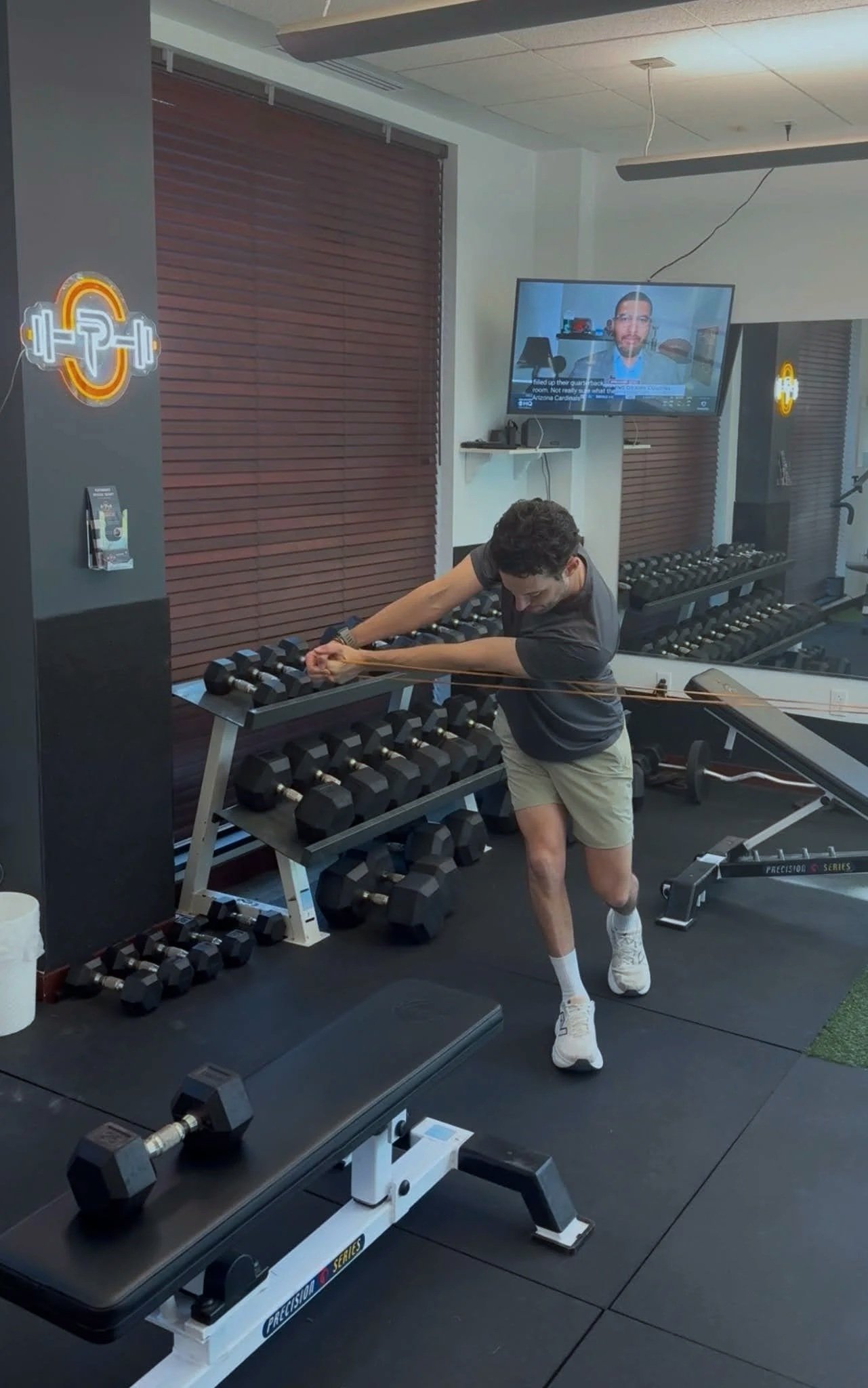
Anti-rotation work, such as Pallof presses and 3D Strap movements, to train the trunk to resist and control rotation. These are performed in a variety of positions and targeted to both the hip turn and the shoulder turn through different movements.
Lower-body power work, such as jumps, to build the ground force that rotation depends on.
Single-leg strength and stability so you can post into your lead side and transfer energy through impact.
The right exercises, loads, and progressions depend on how your body moves, your injury history, and your golf schedule. That's where an assessment comes in.
The SPT Approach: Identify, Restore, Exceed
At Smith Performance Therapy, rotational training follows the same deliberate sequence as every program:
Identify. Dr. Kevin Smith starts with your injury history and a golf-specific movement assessment informed by his Titleist Performance Institute (TPI) certification. That includes how well you can separate your hips from your torso, where rotation is limited, and how your body produces power. Learn more in What to Expect During a Golf Movement Assessment.
Restore. If a restriction or pain is limiting your turn, the focus is on getting you to a pain-free baseline using manual therapy, dry needling, or other treatment when appropriate, along with corrective exercise.
Exceed. From there, your program builds rotational strength and power progressively. Clients lift weights from Day 1, at a level that fits where they are, and progress is tracked with clear metrics, such as clubhead speed and medicine ball throw distance, so you can see what's improving.
Your swing doesn't create your limitations. It reveals them. Building rotational strength on top of a body that moves well is what makes speed gains last.
Rotational Strength Training in Mt. Pleasant and Charleston
Golfers in Mt. Pleasant, Daniel Island, and the greater Charleston area can play year-round, so there's rarely a long off-season to rebuild. That makes it important to train rotational strength in a way that fits around your rounds rather than competing with them.
Dr. Kevin Smith, PT, DPT, OCS, COMT, TPI Certified, works with adult golfers across Mt. Pleasant and Charleston who want more speed, a more repeatable swing, and a body that holds up round after round. Explore our golf performance training services or read more about whether physical therapy can help increase golf swing speed.
Frequently Asked Questions
What is rotational strength in golf?
Rotational strength in golf is the ability to produce, transfer, and control rotational force through your legs, hips, trunk, and arms during the swing. It's what lets your body turn the energy you create from the ground into clubhead speed.
Does rotational strength increase clubhead speed?
Research shows that rotational strength and power are associated with faster clubhead speed. Low-handicap golfers in one study had about 28% more rotational strength than high-handicap golfers, and golf-specific training that included rotational exercises improved torso rotation speed and driving performance.
What are the best rotational exercises for golfers?
Common options include rotational medicine ball throws, cable or band woodchops, anti-rotation exercises like Pallof presses, and lower-body power work such as jumps. The best exercises for you depend on how your body moves and any restrictions identified in an assessment.
Is flexibility or strength more important for golf?
Both play a role. Mobility lets you get into good positions, but research has found that strength and power measures are more strongly associated with clubhead speed than flexibility measures alone. The goal is usable mobility you can control at speed.
How long does it take to improve rotational strength for golf?
In one study, recreational golfers improved torso rotation strength and swing rotation speed after an eight-week golf-specific program performed three to four times per week. Your timeline will depend on your starting point, training consistency, and golf schedule.
Where can I find rotational strength training for golf near me in Mt. Pleasant or Charleston, SC?
Smith Performance Therapy offers golf movement assessments and performance training with Dr. Kevin Smith, PT, DPT, OCS, COMT, TPI Certified, for golfers in Mt. Pleasant and Charleston, SC.
Build a Faster, Stronger Turn
If your drives have plateaued, your swing feels like it's all arms, or you want more speed without paying for it the next morning, rotational strength is a good place to start. Book a golf performance assessment with Dr. Kevin Smith, PT, DPT, OCS, COMT, TPI Certified, at Smith Performance Therapy, serving Mt. Pleasant and Charleston.