
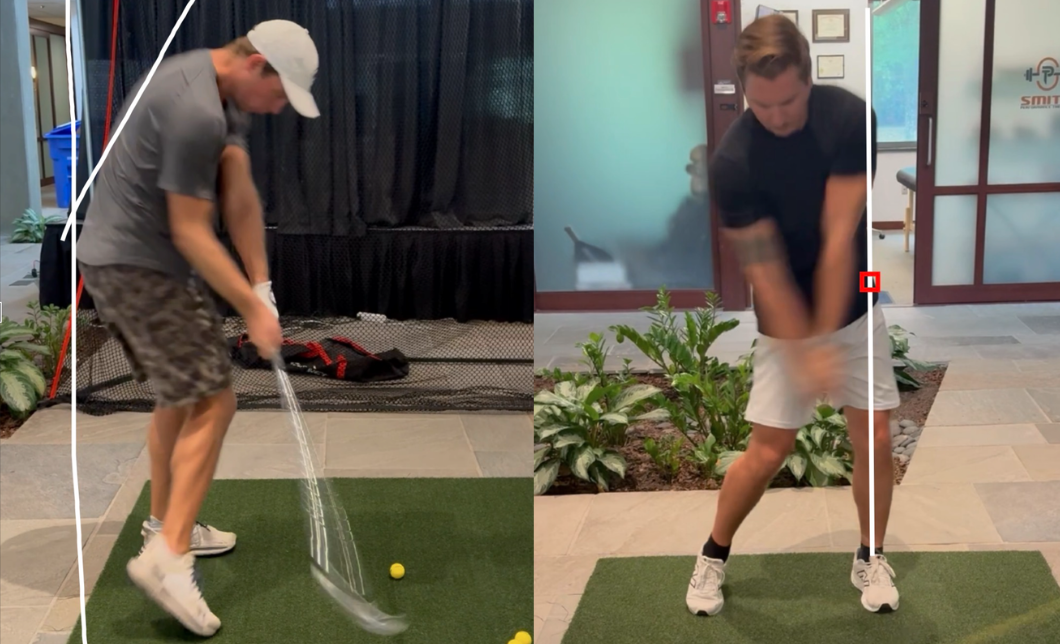
Golfers who want more distance or less pain have plenty of options: new equipment, lessons, speed training, stretching routines. Each can help. What makes them work best is knowing what your body can actually do first, so every hour you put in is aimed at what you need.
The STRIKE Method is how Dr. Kevin Smith, PT, DPT, OCS, COMT, TPI Certified, takes the guesswork out of golf performance training at Smith Performance Therapy. It's a six-step framework that moves a golfer from assessment to the golf course in a deliberate order:
Screen the golf body
Target metrics for range of motion, strength, and speed
Restore range of motion in the four rotary centers: hips, thorax, shoulders, and neck
Integrate strength
Kinematic transfer: layer in speed
Execute: hit your metrics and take it to the golf course
Each step builds on the one before it. Here's what happens at each stage, and why the order matters.
Why Golf Performance Training Needs a System
Strength training works for golfers, but what you train and how you sequence it make a difference. Research has found that combining general strength work with golf-specific training improves clubhead speed more than general strength training alone.
A system keeps your training aimed at the right target, so you aren't stacking speed work on top of a hip that won't rotate or a back that's already sore. That's the job STRIKE does.
STRIKE also fits inside the Identify, Restore, Exceed philosophy that guides every program at Smith Performance Therapy. Screen and Target are how we identify. Restore is how we get you to a pain-free baseline. Integrate, Kinematic Transfer, and Execute are how you exceed where you started.
S: Screen the Golf Body
Every program starts with a screen of how your body moves, not just how your swing looks. Dr. Smith uses a golf-specific movement assessment informed by his Titleist Performance Institute (TPI) certification, along with your injury history and a look at your current training routine.
Screening isn't a formality. It gives us a baseline to measure against, and how it's done matters. For example, adult golfers score noticeably better on the TPI screen after a warm-up than before one. That's why we run your screen and retests the same way each time, so a change in your score reflects a real change in your body.
Want to know what the screen feels like from the client side? Read What to Expect During a Golf Movement Assessment.
T: Target Metrics for Range of Motion, Strength, and Speed
A screen tells us where you are. Targets tell us where you're going. After your screen, Dr. Smith sets specific, measurable goals in three categories:
Range of motion: for example, hip internal rotation on each side, thoracic rotation, and neck rotation.
Strength: lower-body, trunk, and upper-body strength that supports your joints and your swing.
Speed and power: measures such as jump performance, medicine ball throws, and clubhead speed.
These targets are tied to the physical qualities research links to golf performance and comfort. Explosive lower-body power, the kind measured by jumping, is more closely tied to clubhead speed than maximal leg strength. And golfers with low back pain tend to have less rotation in their lead hip than golfers without it.
Clear targets also make progress visible. Instead of "I think I feel better," you'll know whether your hip rotation, your jump, or your clubhead speed moved, and by how much.
R: Restore Range of Motion in the Four Rotary Centers
The golf swing is a rotation that runs through four key areas, which Dr. Smith calls the four rotary centers: the hips, the thorax (mid-back), the shoulders, and the neck. When one of them can't do its share, the swing borrows motion from somewhere else, and that borrowed motion is often where pain shows up.
Hips. The hips start the downswing and absorb a large share of the rotation. Limited lead hip rotation is one of the most common places that borrowed motion starts. For a deeper look, see The Connection Between Hip Mobility and Golf Swing Speed.
Thorax. Your mid-back is where much of your upper-body turn should come from. Golfers who create more separation between the torso and pelvis, and move through it faster, tend to produce higher ball speed. That separation depends on a mid-back that can rotate independently of the hips.
Shoulders. The shoulders have to let the arms travel through the backswing and finish without forcing extra motion from the spine. Along with the low back and neck, the shoulder region is one of the most common areas golfers seek care for, and that pain is usually linked to movement and reduced range of motion.
Neck. Your head stays relatively steady while your body turns underneath it, so the neck rotates relative to your torso on every full swing. Neck range of motion naturally decreases with age, which makes it worth screening for golfers over 35, even when it doesn't hurt.
Restoring these areas may involve manual therapy, dry needling, or other treatment when appropriate, along with corrective exercise. The goal is a pain-free baseline and usable range of motion, meaning rotation you can control, not just reach on a stretching mat. For some areas, especially a neck with long-standing symptoms, the priority is reducing movement-related pain and building control rather than chasing more range.
Mobility on its own isn't what makes the ball go farther. It gives your body the positions it needs and takes pressure off areas that shouldn't be doing extra work. Strength and speed, the next steps, are what turn those positions into distance. For common restrictions, see 7 Mobility Restrictions That Impact Your Golf Swing.
I: Integrate Strength
Once you can move well, it's time to build strength on top of that movement. At Smith Performance Therapy, clients lift weights from Day 1, at a level that fits where they are. During the Restore phase that might mean lighter loads alongside mobility work. As range of motion improves, the strength work progresses.
Strength training isn't just for younger golfers. The National Strength and Conditioning Association recommends strength training two to three times per week for older adults and notes that well-designed programs with proper instruction are safe for healthy older adults.
"Integrate" is the key word. Strength isn't a separate workout stacked on top of golf. It's chosen to support the positions you restored, the joints you need to protect, and the rotational demands of your swing. For more on that last piece, read Why Rotational Strength Matters for Golf Performance.
K: Kinematic Transfer, Layering in Speed
Clubhead speed isn't produced by one muscle. It's produced by a sequence. In an efficient swing, the pelvis, then the torso, then the arms and hands reach peak speed one after another, each segment passing energy to the next. This is called the kinematic sequence, and skilled golfers show this pattern on every kind of shot, from partial wedges to full drivers.
Kinematic transfer is the stage where we teach your body to use its new mobility and strength fast and in the right order. Training at this stage often includes:
Explosive lower-body work, such as jumps, because ground force is where the sequence starts.
Rotational and upper-body power work, such as medicine ball throws.
Golf-specific speed work that connects gym power to the swing itself.
Speed is layered in after strength because power is one of the strongest drivers of clubhead speed. Among PGA professionals, jump and medicine ball throw performance explained most of the difference in clubhead speed from one player to the next.
Speed work also has a place before you play. A few explosive movements in your pre-round routine can help you start the round ready to swing. For ideas, see Golf Warm-Up Routines to Improve Mobility and Reduce Injury Risk.
E: Execute, Hit Your Metrics and Take It to the Golf Course
The final step is where the work shows up where it counts. Execute has two parts.
Hit your metrics. We retest against the targets set in Step T: range of motion, strength, power, and clubhead speed. Because screens and tests are standardized, you can trust that the changes you see are real. If a number isn't moving, that tells us to adjust the plan rather than keep guessing.
Take it to the golf course. Gym numbers matter only if they carry over to your game. That's why the program is built around your golf schedule, with training timed so you aren't showing up to a Saturday round sore from Friday's session, and why we pay attention to how your body holds up late in the round, not just on the first tee.
This kind of training does reach the course. Recreational golfers who completed an eight-week golf-specific exercise program improved their torso rotation strength and speed, along with ball speed and driving distance.
STRIKE at Smith Performance Therapy in Mt. Pleasant and Charleston
Golfers in Mt. Pleasant, Daniel Island, and the greater Charleston area can play year-round, which is great for your game and tough on your body. Without a long off-season to reset, training has to fit around your rounds instead of competing with them. STRIKE is built for that. Each phase is matched to your schedule, your injury history, and the goals you set together with Dr. Smith.
Dr. Kevin Smith, PT, DPT, OCS, COMT, TPI Certified, is a Board-Certified Orthopedic Clinical Specialist who works with active adults and golfers across Mt. Pleasant and Charleston. Learn more about our golf performance training services, or read Golf Performance Training for Adult Golfers Over 40.
Frequently Asked Questions
What is the STRIKE Method for golf?
STRIKE is Smith Performance Therapy's six-step golf performance framework: Screen the golf body, Target metrics, Restore range of motion in the four rotary centers, Integrate strength, Kinematic transfer to layer in speed, and Execute on the golf course. It was developed by Dr. Kevin Smith to move golfers from assessment to measurable results in a deliberate order.
What are the four rotary centers in the golf swing?
The four rotary centers are the hips, the thorax (mid-back), the shoulders, and the neck. Each one contributes rotation to the swing. When one is restricted, other areas often compensate, which can limit speed or contribute to pain.
What metrics are tracked in golf performance training?
Common metrics include range of motion at the hips, mid-back, shoulders, and neck; strength measures; power measures such as jumps and medicine ball throws; and clubhead speed.
Why does mobility come before speed training?
Speed training asks your body to rotate quickly and forcefully. If a hip, the mid-back, or the neck can't rotate well, that force often gets redirected to areas like the low back. Restoring usable range of motion first gives your body the positions it needs so strength and speed can build on a solid, pain-free base.
What is the kinematic sequence in golf?
The kinematic sequence is the order in which the body's segments reach peak speed during the downswing, typically the pelvis, then the torso, then the arms and hands. Training it helps your body pass energy efficiently from the ground to the club.
Where can I find golf performance training near me in Mt. Pleasant or Charleston, SC?
Smith Performance Therapy offers golf movement assessments and STRIKE-based performance training with Dr. Kevin Smith, PT, DPT, OCS, COMT, TPI Certified, for golfers in Mt. Pleasant and Charleston, SC.
Start Your STRIKE Program
If you want more distance, a swing that feels better, or a body that holds up from the first tee to the 18th green, STRIKE starts with a screen. Book a golf performance assessment with Dr. Kevin Smith, PT, DPT, OCS, COMT, TPI Certified, at Smith Performance Therapy, serving Mt. Pleasant and Charleston.